

War or Peace?
The State of War and Peace

A state of war arises from the impossibility of defining war or peace.
The distinction between a state of war and a state of peace lies in the inability to define the limits of military action aimed at establishing “governance”—which is, first and foremost, how civil society establishes a stable majority government.
When an intermediate state between war and peace takes hold, a form of misrule emerges, characterized by the arbitrary use of indiscriminate military force to pursue political objectives.
This obliterates the possibility of a stable majority government, as the civil society responsible for defining public policy and governance becomes tethered to vague military goals.
This latent state of war arises when “governance” is rendered unable to define public policy due to the pressing demands of military objectives; those in charge neither truly govern nor command, unable to establish stable majority governments, thereby creating an intermediate state between war and peace.
This intermediate state creates a limbo of “ungovernance” where it is impossible to clearly define what constitutes “civil” or “military” power.
This erodes the legitimacy of the “majority” government itself, which becomes secondary to the magnitude with which vague military concepts impose themselves upon the government and the Nation-State—a State that effectively becomes “theirs” rather than belonging to the majority.
The State of War

A state of war arises when clear military objectives clash with political objectives, creating a threat to the security of the State and its institutions.
This threat aims to destroy the State’s most fundamental elements of defense and security, ultimately redefining the boundaries of both national sovereignty and the State’s most basic defense and security perimeters.
War is essentially a threat to the boundaries between national sovereignty and security—boundaries where the use of military forces is essential to guarantee borders and fundamental security perimeters, defining the limits of these basic defense perimeters is what creates a state of war; a dichotomy between war and peace emerges when the definition of these limits expands or contracts based on vague, essentially political objectives.
The Dilemmas of War and Peace

A dichotomy between war and peace arises when political objectives obliterate vague military objectives—and vice versa—due to the impossibility of clearly defining the fundamental limits of the defense perimeter between national sovereignty and State security, as these boundaries are constantly being altered or obliterated by issues of an essentially political nature.
If the definition of a nation-state’s borders becomes a matter that is essentially political—fluid and changeable—the history of those boundaries is lost from view, as is the understanding of how the state exercises its sovereignty and the certainty with which it defines its historical limits.
If the state’s current history fails to clearly define its boundaries, it is because those limits have shifted over time, creating a dichotomy between its past history and the boundaries of its defensive perimeters—whether driven by the concept of a state without future limits or by attempts to reclaim histories lost to time.
For whatever reason, as the nation-state loses sight of the objectives that originally established its historical borders—and thus the fundamental perimeters within which it exercises sovereignty and defense—a dilemma between war and peace arises.
War is War!
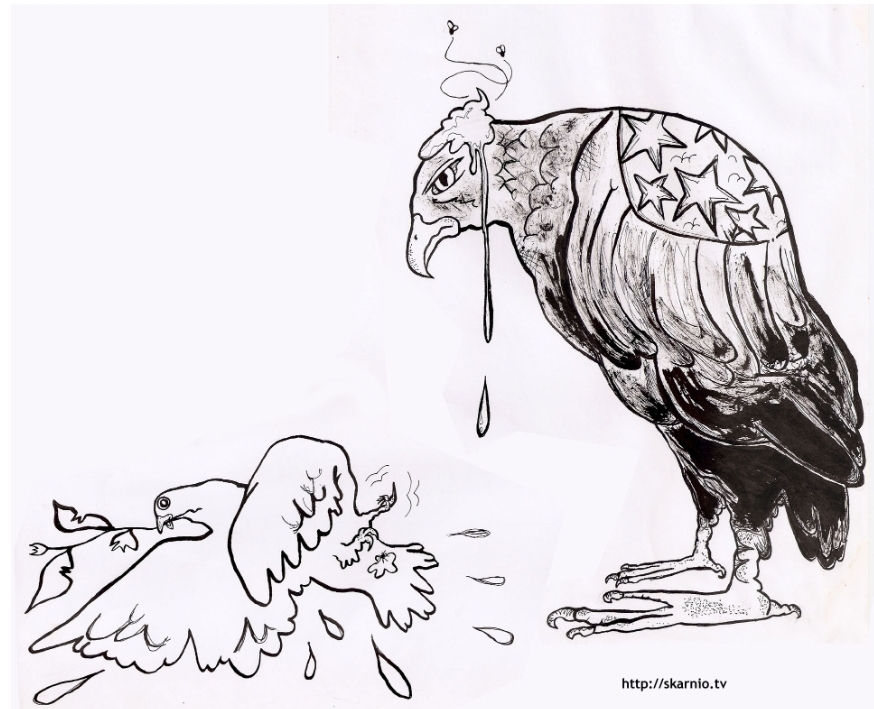
The dilemma between war and peace creates further dilemmas that hinder the establishment of governance, and Civil society becomes unable to define a stable majority-based government, as it is subjected to the pressures of a permanent state of war—driven by constant shifts in the historical definition of borders and the perimeter of national security and defense.
Consequently, civil society loses sight of the goal of establishing a stable majority government, overwhelmed by the exigencies of shifting military objectives.
These objectives constantly override the will of the majority, leading to unstable governments that seek unattainable legitimacy to mask the fact that they represent (vague) military goals rather than the majority of the population.
As “governance” ceases to be rule by the majority, civil power dissolves, giving way to military power with essentially political objectives.
The establishment of military power with political objectives creates a state of undeclared war—convenient for a State lacking a history of clear, well-defined borders, whether due to expansionist political ambitions or a perpetual quest to reclaim a history of borders and sovereignty lost to time.
Thus, a State lacking a history of stable borders cannot define clear boundaries or national security parameters.
It may even incorporate neighboring states into its national security objectives and defense perimeters, creating a permanent state of conflict that justifies war.
This creates a vicious cycle: military interventions with political aims alternate with the establishment of fractured civilian governments lacking majority support, ultimately resulting in wars devoid of clear military objectives.
Ultimately, this state of war—spawned by “political” military objectives—leads to military actions that obliterate the very essence of military goals.
The result is either lost wars or unattainable victories, as military actions remain constantly pressured by the war-versus-peace dilemma, undermining the establishment of stable governance and majority-based governments.
By Professor Ricardo Gomes Rodrigues
Sao Carlos, SP, Brazil, June 21, 202


Comentários